Handmade in York, PA — Each Piece One of a Kind
6 min read
·
When I tell people I have a Bachelor's in Art from California University of Pennsylvania, the follow-up question is almost always the same: "So how did you end up dyeing sweatshirts?" They ask it kindly, but there's usually an assumption baked in, that making ice-dyed apparel is somehow a detour from where an art degree was supposed to take me. It's not. Every class I sat through, every color wheel I mixed by hand, every critique where a professor challenged me to explain why I chose the colors I chose. All of that lives in the work I do now.
The path just doesn't look the way people expect. There's no gallery. No MFA. No teaching position. There's a dye studio in York, PA with industrial washers, bins of Procion MX pigment, and racks of one-of-a-kind apparel drying under fluorescent lights. And honestly, I think the work I'm doing here is more connected to what I studied than most traditional art careers would be.
California University of Pennsylvania's art program was broad: painting, drawing, sculpture, art history, design fundamentals. But the classes that shaped me most were the ones focused on color theory. How hues interact. How warm and cool tones push and pull against each other. How complementary colors vibrate at their edges and analogous colors create harmony. How value and saturation affect the emotional weight of a composition.
I didn't just learn color theory from a textbook. I mixed paint by hand, starting from primary pigments and building every color I needed. That hands-on understanding of how pigments combine is directly transferable to ice dye. When I sprinkle Procion MX dye powder onto ice, I'm making the same decisions I made in painting class: which pigments to place next to each other, how much space to leave between colors, where to let hues blend and where to create contrast.
The difference is the medium. Instead of canvas, it's cotton. Instead of brushes, it's ice and gravity. Instead of full control over every mark, there's a collaboration with chemistry that makes each outcome unpredictable. But the foundational knowledge — the understanding of why certain colors work together and others fight — that comes directly from art school.

Along with my art degree, I also earned a Cosmetology and Massage Therapy License. People usually treat that as a separate thing, a different career track. But the overlap is bigger than it sounds.
Cosmetology taught me how pigment bonds to fiber at a molecular level. Hair color theory is remarkably similar to textile dye theory: you're working with a substrate (hair fiber or cotton fiber), a chemical process that opens the structure to accept pigment (developer or soda ash), and pigments that behave differently depending on the base color and the processing conditions. Understanding how color lifts, deposits, and develops over time in hair gave me an intuitive feel for how dye interacts with fabric that goes beyond what most self-taught dyers develop.
The massage therapy side gave me something less obvious but equally valuable: an understanding of how to work with my hands for extended periods without injury. Dyeing is physical work. I'm scrunching, folding, manipulating wet fabric, lifting bins of ice, standing at rinse stations for hours. The body mechanics I learned through massage therapy training have kept me working sustainably in a profession that's harder on the hands and back than people realize.
Every ice dye colorway I develop starts with a color theory decision. Not a random grab from the pigment shelf. A deliberate choice about what story I want the colors to tell.
When I create a piece using analogous colors (say, a range from deep teal through seafoam to golden chartreuse) the result has a natural, harmonious quality. The colors flow into each other because they sit next to each other on the color wheel. The piece feels calm, cohesive, almost meditative. This is the kind of colorway that appeals to people who love color but want something that doesn't shout.
When I work with complementary colors, like purple against gold or teal against rust, the piece has tension. The colors push against each other at their edges and create visual energy. These are the pieces that stop people mid-scroll on Instagram. They're bold. They demand attention. They're what I mean when I talk about "color with backbone."
And then there's the pigment splitting, which is where ice dye does something no other medium does quite the same way. A single dye color often contains multiple pigments that separate as the ice slowly carries them through the fabric. "Boysenberry" fractures into plum, rose pink, and pale lavender. "Jade" splits into teal, seafoam, and chartreuse. Understanding the component pigments inside each dye — and how those components will interact with neighboring colors — is where my color theory training becomes a real competitive advantage.
Unlike mass-produced tie dye, my boutique focuses on deliberate color placement to create unique items that cannot be duplicated. That comes from education. It comes from years of training my eye to see relationships between colors that most people feel but can't articulate.

There's a bias in how people think about art degrees. The assumption is that "real art" hangs on walls or sits in sculpture gardens. Wearable art gets treated as craft, something less than. I pushed against that thinking in college, and I push against it now.
The pieces I create involve the same skill set as any studio art practice: composition, color relationships, understanding of materials, creative problem-solving, and the ability to work within constraints while still making something that surprises you. The constraint in ice dye is the medium itself. I can influence the outcome but never fully control it. That tension between planning and unpredictability is what makes each piece truly one of a kind.
My art education didn't prepare me for a specific career. It prepared me for any career that requires deep visual thinking. Ice dye happened to be the medium where all my training (fine arts, color theory, cosmetology, hands-on craft) converged into something that works as both art and business.

I started selling on Etsy in 2015, making Swarovski crystal jewelry at the kitchen table after my daughters went to bed. The art degree was in the background, informing my color choices, my design sense, my understanding of what makes a piece feel considered rather than accidental. By 2019, I had my business license and my own Shopify store. By 2021, I was deep into ice dye apparel and discovering that this was the medium I'd been circling around my entire creative life.
Now I run a full dye studio with industrial equipment, a wholesale program serving businesses like Pine Ridge Campground and local fire departments, and a boutique that ships one-of-a-kind pieces to customers who care about color as much as I do. The studio doesn't look like a painting class at Cal U. But the thinking that happens inside it is the same thinking I was trained to do.
If you want to see what deliberate color placement looks like on fabric, browse the ready-to-ship collection. Every piece in there represents a set of real color theory decisions: which pigments to combine, where to place them, how to let the ice create movement between hues. And if you're curious about the specific colorways I reach for most often, I broke down my favorites in a post about the best ice dye color combinations and why they work.
A fine arts degree doesn't always lead to a gallery. Sometimes it leads to a studio full of dye bins and a career built on the belief that what people wear can be art too.
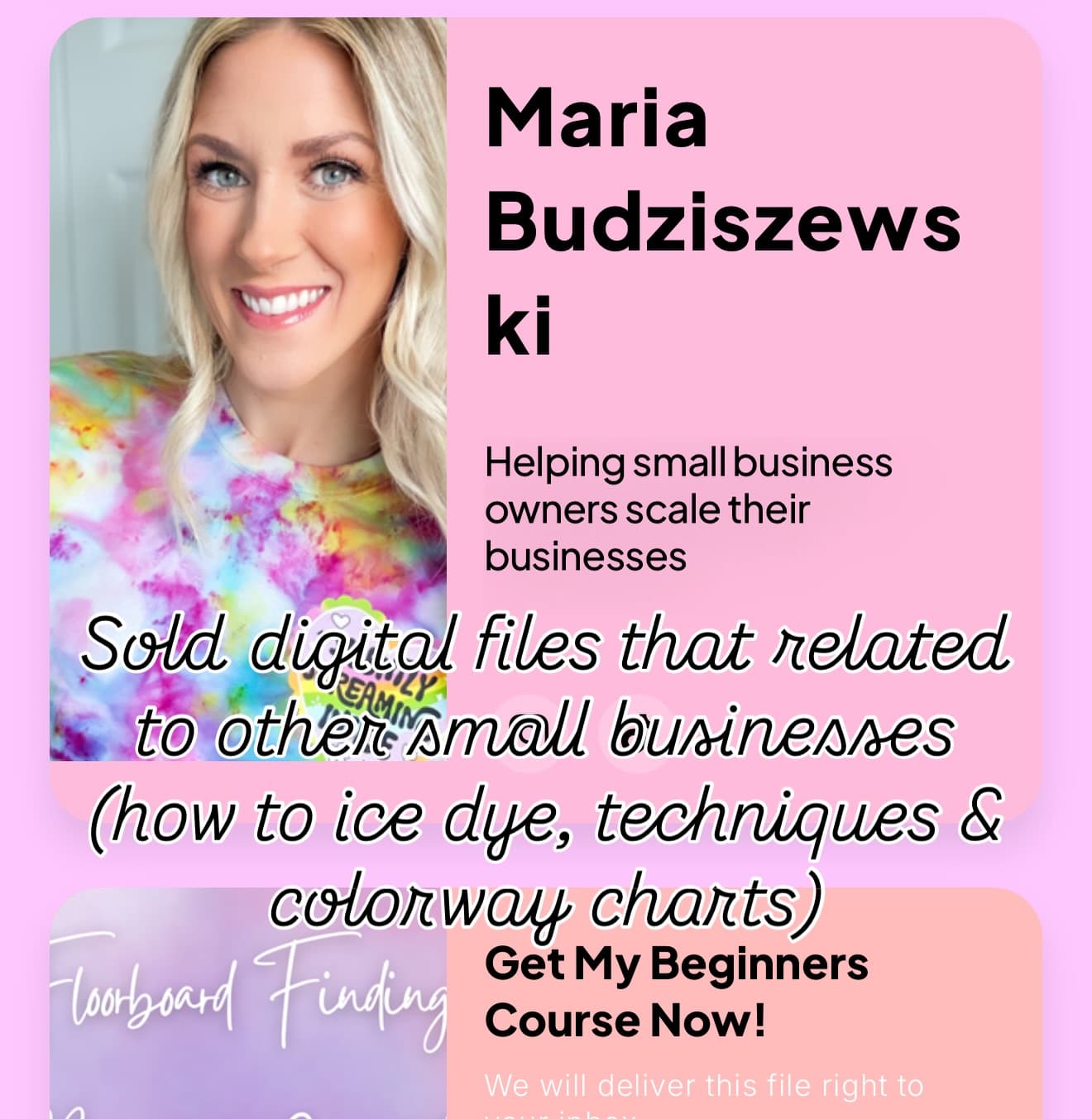
Maria Budziszewski
Owner & Creator
Every piece is hand-dyed with care in York, PA. From ice dye hoodies to crystal jewelry, each item is crafted to be one-of-a-kind.
Meet the creator →Love what you see?
Shop our handmade ice dye apparel, graphic tees, and crystal jewelry.
Browse CollectionsMore from the Journal
 Behind the Scenes
May 1, 2026
Maria Budziszewski
·8 min read
A full walkthrough of how ice dye is made in my York, PA studio — from the white blank to the finished piece in your mailbox. Every step, every mess, every moment where chemistry meets art.
 Behind the Scenes
May 15, 2027
Maria Budziszewski
·6 min read
A behind-the-scenes look at the print methods, blank choices, and quality standards behind every custom graphic tee that leaves our York, PA studio.
 Behind the Scenes
October 1, 2027
Maria Budziszewski
·6 min read
A look behind the scenes at how every Floorboard Findings order gets packed, from branded leopard stripe mailers to handwritten notes and care inserts.